Trump Shock: Eight Takeaways From This Week’s Election Stunner
-
Read More
The Denizen'south politics page
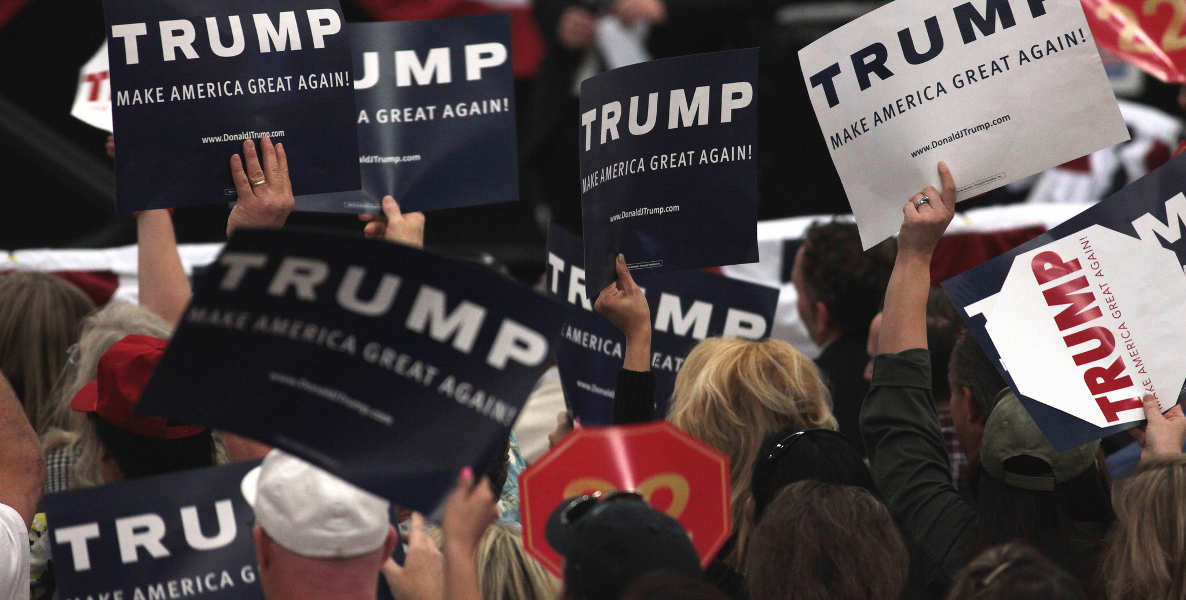
Trump Shock
Trump Shock
8 takeaways from this calendar week'due south ballot stunner
Nov. xi, 2016


As political scientists and journalists take apart Tuesday's ballot, we will acquire more than well-nigh how this happened. Right now many of usa are in a land of disbelief. While I work through the 5 levels of grief (I am far from acceptance), here are 8 takeaways from the seismic sea wave nosotros just witnessed:
- President Obama may exist the best one-off political effigy of our time: The President was never able to translate his electoral successes into the political expansion of the Democratic Political party. Throughout most of the eight years of his presidency, Republicans picked up seats in the Business firm and Senate and they rolled up victories in governorships and land houses. In 2008, Democrats had a bulk of governorships and land houses; those numbers take declined dramatically since that fourth dimension. Obama redefined what was possible in America in pregnant ways, but what that ultimately meant for the Democratic Party is less clear. He was transformational every bit an intellect, personality and symbol—but less so equally a political leader or movement architect.
- Trump blew up the national Republican Party: Trump congenital a coalition of non-aristocracy Republican moderates and conservatives forth with industrial area independents and Democrats. He merged those two overwhelmingly white constituencies into a populist and nationalist movement, alienated past global change. His bulletin organized Rust Belt workers from Pennsylvania, Ohio, Michigan, and Wisconsin, who used to be a critical function of the Autonomous Party, into an anti-merchandise constituency. Is this a new recipe for a Republican Party whose elites, from the National Review to the Cato Establish, were hostile to Trump'southward anti-immigration and anti-free trade rhetoric? How volition Trump'southward deviation from free market conservatism and neocon strange policy play out with Republicans in the House and Senate? Nobody knows.
The end of Clinton influence in the Democratic Party has arrived. Democrats demand to do a real listening tour in places like the Rust Belt, not for political theater, but to bridge the disconnection between the political donor class and fly-over country.
- The 2022 Republican autopsy was right, just not even so: Neocon David Frum, a former George W. Bush speechwriter, wrote a groovy autopsy for the Republicans after Mitt Romney's 2022 defeat. He argued that if the Republican Party was to compete as a national party it must expand its base in a nation that is changing dramatically, every bit a result of immigration and the greying of the traditional Republican base. Frum and others also argued that some of the Republican focus on social issues was politically deadly in a culture war they had largely lost. I think Frum was right, even though that was not the playbook Trump used. Yet if the Republicans do not have that critique seriously— if they overplay their electric current hand—they will have trouble over the long term.
- The Democrats have an identity crisis: And so what will the 2022 Autonomous Political party autopsy look like? I think it will accept to exercise with the Party'southward identity crunch as it relates to economical growth policy. The Bernie-Hillary contest was one manifestation of the crisis: How left (socialist) versus centrist (social democratic) is the political party? The Dems are made up of coastal metropolitan hubs, college towns, African American and Latino communities, immigrants, and important civil rights and social identity groups such as the LGBTQ community, women'south rights constituencies, and environmentalists. Put those groups together with economic elites from media, finance, and technology and you accept today's Democratic coalition. But the parts have to add upward to a coherent whole regarding the economic system. The Democrats cannot just be a list of groups (let alone a list of grievances); they must accept a common economic vision that speaks to equity concerns every bit well equally national economical growth. That vision will have to exist congenital on a more nuanced understanding of our advantages and disadvantages in the global economy than the political entrada season would let.
-
 The revolt against elites reached a boiling point: In 1994, the cultural theorist Christopher Lasch wrote Revolt of the Elites and the Betrayal of Democracy . Playing off of Ortega y Gasset's 1929 publication Revolt of the Masses that described the ascension of the mass movements overtaking Europe, Lasch turned the argument on its caput. He identified our time as a catamenia when well-educated and wealthy elites with common backgrounds and affiliations could withdraw from local and national life, adopting transnational relationships and culturally protected enclaves. This was their revolt, an exit from ordinary public life. Lasch'due south elites are liberal with respect to social diversity values but increasingly disconnected from the lives of their countrymen. Moreover, while they exert bang-up cultural and political influence through regime, universities, think tanks, corporations, and philanthropy, they practice not have to play past conventional rules or constraints. More than at other times, today's elites are absentee landlords. If you call back a defection against economical and cultural elites was not a commuter of this election, y'all are living under a stone. How this reaction manifests in the future is the question many are nervously asking.
 - The national media lost enormous credibility: This is an obvious takeaway but still worth mentioning. The line betwixt commentators, political operatives, and journalists was breached. One Fox program functioned as a de facto Trump campaign function. I CNN commentator shared debate questions with the Democratic National Commission. News formats were partisan debates from the usual suspects and largely played out in a fact free zone. Some of the trouble is structural. The proliferation of politically-segmented news sources and blogs has naturally infected television stations competing for audience. Cable news plays to segmented political markets: Flim-flam to the correct and MSNBC to the left. Moreover, social media and the Cyberspace make it possible for low content news services and aggregators to yield enormous power. Drudge and Breitbart were more important to the success of Trump than the Republican National Committee. The national media needs to ask itself tough questions well-nigh roles and standards. We no longer have a common fix of facts delivered from voices we trust. The increasingly partisan entertainers degrade commonwealth.
To win, the Democrats cannot only exist a list of groups (or a list of grievances); they must have a mutual economic vision that speaks to equity concerns every bit well as national economic growth.
- Clinton Inc. is Over: Hillary Clinton showed enormous nobility in how she handled defeat. She was the gracious patriot who said it is time to remember nosotros are one nation and Trump volition be our President. The candidate who thought she was a shoo-in in 2008 but lost to an unexpected outsider, lost to another outsider despite having enormous advantages of feel, money, political demography, and party arrangement. The end of Clinton influence in the Democratic Political party has arrived. Loyalists will become on television and say she is still the head of the Autonomous Party. Only information technology is not then, or at least it should non be and then. The Party needs to move on from Hillary and Bill. The sooner Democrats come to terms with that, the better. And they need to do a existent listening tour in places similar the Rust Belt, not for political theater, but to span the disconnect between the political donor grade and fly-over country.
- The Boxing of Cultural Bubbles: Nosotros have national divisions of race and social form, an enormous number of strange built-in citizens, the ability of gerrymandering to create condom districts, and a news delivery system that reinforces rather than challenges our views. The result: Nosotros increasingly live in narrowly-defined idea bubbles. Nosotros talk and mind to similar-minded people. Many of usa alive in political districts that take been Democratic or Republican since the Neolithic. Politicians practise non accept to seek votes from those that may disagree with them. Retrieve of the Commonwealth of Pennsylvania, where dozens of legislators run unopposed every two years. The battle betwixt Trump and Clinton was a battle between vastly different narratives regarding the state of the nation. No candidate felt the need to cantankerous lanes and it is likely neither candidate knew how to practise just that.
The election is over and now governing begins. Permit's hope we pay as close attention to that every bit we did to all the off-putting entrada rhetoric. And let's become involved more than e'er. The future is too important to go out to politicians.
Photo header: Flickr/Gage Skidmore 
Source: https://thephiladelphiacitizen.org/trump-shock/

Post a Comment for "Trump Shock: Eight Takeaways From This Week’s Election Stunner"